MantiSpectra | Miniaturized Spectral Sensors

Behind our technology

What is NIR Spectroscopy?

Near-Infrared (NIR) Spectroscopy is based on the absorption of molecules in the near-infrared part of the electromagnetic spectrum. 

The core principle is simple: light is emitted by a light source such as a tungsten lamp and its spectrum is selectively absorbed by the molecules of a target object resulting in a ‘fingerprint’ of the material. The light that interacts with the object is measured via a spectrometer, an instrument that typically contains a moving grating, and a single detector to resolve the spectrum.

The spectrum is then compared to a database and the properties of the object can be quantified and/or the material classified.

After its first application in the agricultural sector starting in the 1960s, NIR spectroscopy has been used in many fields ranging from process analysis to pharmaceutics and quality control. However current spectrometers are still bulky and expensive which currently limits their application to labs and industrial control.

Discover SpectralPod

Competitive Advantages of our technology

The Unique MantiSpectra’s breakthrough innovation heavily relies on fully integrated technology based on the Indium Phosphide platform developed at TU/e.

The proposed innovation fills a gap in spectral sensing technologies, having a current spectral range up to 1700 nm. It also features a series of technological advantages over competing technologies:

  • No moving parts
  • Low dark current and high signal to noise ratio (~10000 SNR)
  • Fast: multi-pixel read-out in less than few seconds
  • Scale to medium and high volume production
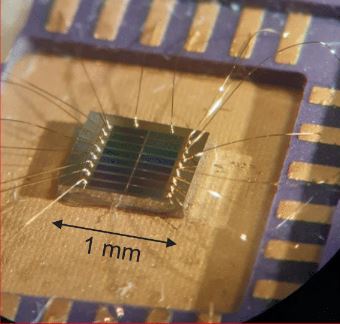
Image of the ChipSense™ at the core of MantiSpectra Technology: Made of 16 pixels

MantiS Near-infrared spectral sensors

In-situ analysis has recently driven the development of portable spectroscopy that does not require bringing a sample to a dedicated lab.  

In this regard, mini-spectrometers have been realized based on various technologies such as, micro-electromechanical systems (MEMS) or Fourier-transformed interferometers or dispersive gratings and waveguides.

However, most of these solutions are affected by mechanical vibrations, have limited spectral range, need re-calibration, or have a limited signal-to-noise ratio. This motivated us to ask the following question: Can we find a much simpler solution?

Getting inspired by nature

Vision systems found in the animal kingdom make use of a limited set of photodetectors to distinguish different materials and objects. Our eyes are extraordinary examples: they contain only four photoreceptors with overlapping spectral responses. However they  their spectral range is limited to the visible, and most chemical information is encoded at longer wavelengths.

That is why we developed ChipSense™: a multi-pixel array containing sixteen detectors fabricated with standard semiconductor processing and having high responsivity in the NIR region spanning from 850 to 1700 nm.


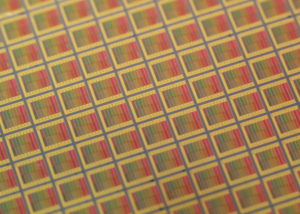
Thanks to the co-integration of filtering functionality and detector at a wafer level, mass manufacturing is possible to scale volume and reduce the price.

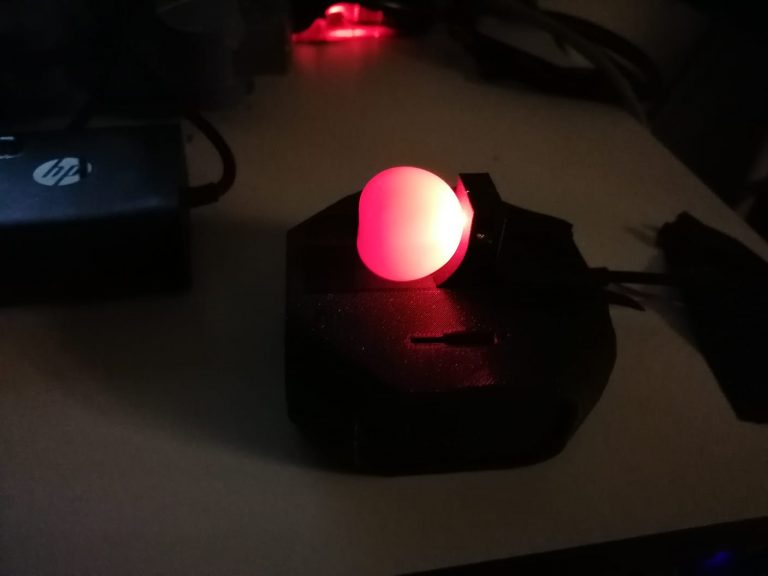
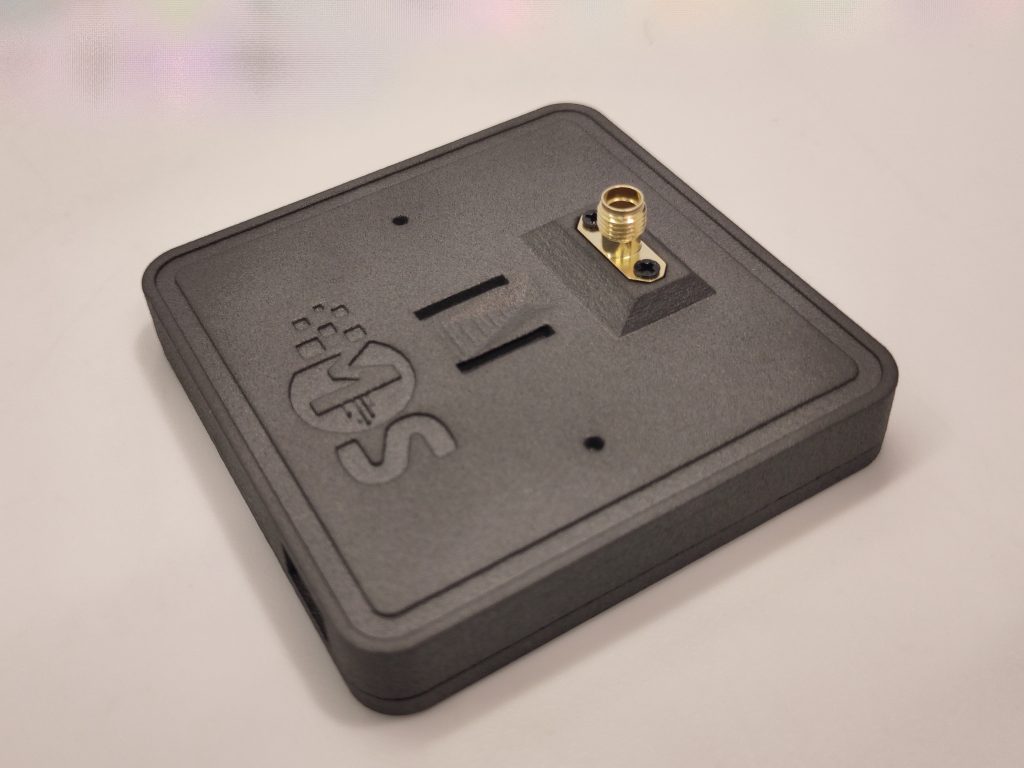
ChipSense can be used in a handheld scanner: The SpectraPod.

CASE STUDY

Our Recent Case Studies

Artificial Intelligence

Officia deserunt mollitia animi nobis

User Research

Molestiae non recusana delectuse

Machine Learning

Exercitation ullamco laboris nisa

Data Science

Duis aute irure dolor inreprehenderit

Safe Security

Quisquam est aui doloreiasum ruia

Technical Support

Raiores alias conseuatuaut alias

TESTIMONIALS

Hear it From Our Clients

testimonial-icon01.png
testimonial-icon02.png
testimonial-icon03.png
testimonial-icon04.png

“Quisquam est, qui dolorem ipsum quia dolor sit amet conse aetur, adipisci velit, sed quia non numquam eius modi temor incidunt ut labore et dolore magnam alieuam zuaerat voluta tem nostrum exercitationem”

Peter Johns Head of informatics at EBI

“Quisquam est, qui dolorem ipsum quia dolor sit amet conse aetur, adipisci velit, sed quia non numquam eius modi temor incidunt ut labore et dolore magnam alieuam zuaerat voluta tem nostrum exercitationem”

Peter Johns Head of informatics at EBI

“Quisquam est, qui dolorem ipsum quia dolor sit amet conse aetur, adipisci velit, sed quia non numquam eius modi temor incidunt ut labore et dolore magnam alieuam zuaerat voluta tem nostrum exercitationem”

Peter Johns Head of informatics at EBI

Want to test it out?